
Metacognition is the way we understand or think about our own thought processes. This mode of self-aware thinking goes beyond experiences and emotions to investigate how we think about situations and why. With that new awareness, we can reframe our thinking to adapt to new situations and emotions.
Metacognition in the Classroom
In the classroom, metacognitive skills allow students to think about how they consider, process, and learn information. Students can face confusion and ask themselves why that information is challenging. Then they can work through that challenge and develop the skills to overcome it.
This might look like:
- A student realizing they need more time to study certain subjects than others.
- Or, a student recognizing that to grasp a concept they have to work through it backward.
Metacognition is a method for students to determine when they know of a topic versus when they fully comprehend that topic. Teachers can equip students with the self-awareness to develop individualized problem-solving skills by teaching them how to understand their unique learning experiences. That adaptability is a foundation for students to see their learning as developmental/growable instead of fixed, meaning they’ll understand that how they learn can change as their knowledge and abilities advance.
Developing Metacognitive Skills in Children
There’s great value in teaching students what metacognition is at a young age. Giving children metacognitive skills empowers them to enhance their learning and become more confident, independent learners.
Teaching Metacognitive Skills
You have to understand what metacognition is for yourself before you teach it. This will help you to consider how you teach and the reasoning behind your methods. It also brings awareness to your thought process, and then you are better able to model that thought process for your students by thinking out loud.
Modelling the process behind the lesson in the lesson will show students how they can break down their own thought processes. They’ll see how a deeper level of thought goes beyond the lesson content to engage with that lesson. They can also actively draw on other learning in order to apply it to that lesson and make metacognitive links.
Lesson Reflection
The primary benefit of using metacognitive skills in the classroom is helping students identify weaknesses in their current learning processes.
Post lesson reflection exercises prompt students to consider how they interacted with the material and push them to consider new approaches to learning. Have students answer these reflective questions, either verbally or in written form:
Today, I learned ____.
I struggled with ____ because ____.
I thought differently about ____ because ____.
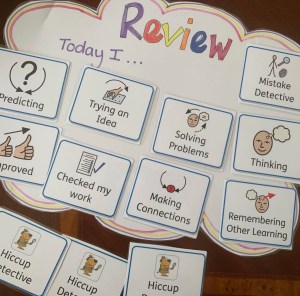
With my younger students in a 1-1 intervention sessions I also use a visual tool for self reflection (pictured below) which helps them to think about all the skills used in that session.
Students can compare what they understand with what they don’t understand. By using metacognition to think deeper about both, students can consider how and why they grasp one part of the lesson and see if any related strategies can help them overcome the challenging part of the lesson.
Metacognition is Collective
This method is valuable for teachers who feel like they’re constantly fielding questions! Direct your students to use metacognitive skills to inquire of themselves before coming to you. It could be a check list on the desk, a set of questions to ask themselves or in pairs or even a review sheet like above. By doing this students begin to think in a deeper way about their learning and more about ‘how’ they learn.
Modelling your process of metacognitive thinking as you deliver the lesson can help students as they try to comprehend the material. By understanding your thought process, students should be able to retrace those steps and consider how you might answer any questions they have. Thus, the power to problem solve is in their own hands.
It could be as simple as showing sounding out and blending when reading or modelling a shared write when you’re talking out load explaining your thought process.
If they are still having trouble, students should then try and problem solve as a group, this will help classmates consider if they themselves fully comprehend the material. If they do, they’ll use metacognitive thinking to explain the lesson to the original student or If they don’t understand, then the group can pose the question to you.
Metacognition is such a huge topic in learning and there is lots of new research coming out about the importance of teaching these skill to students. As a dyslexia specialist teacher we were taught the importance of metacognition in my training and include a metacognitive review in each structured literacy session we teach.
Want to know more? Let me know below and I can share more practice ways we can use in in the classroom in a future post!
K x

 Adapted Learning
Leave a comment