

What is a Schwa Sound?
Not only is it fun to say, schwa is actually derived from Hebrew.
Schwa refers to the most common vowel sound in the English language.
Schwa is the sound a vowel makes in an unstressed syllable and is represented by the phonetic symbol /Ə/ (like an upside-down, reversed e).
Not only is the schwa sound common, but it can be spelled with any vowel, which can make writing and spelling schwa sounds a challenge for students.
Sch-when and Sch-where is Schwa?
Vowels don’t make their long or short sounds when they appear in unstressed syllables. As schwa sounds, these vowels commonly sound like /uh/ (like the sound people make when they’re thinking).
For a quick example, let’s use the word:
Alaska
If you sound it out, paying attention to the schwa ‘a’ sound, it sounds like
uh-lask-uh
Note how the second syllable is stressed while the first and third are not.
The stressed second syllable has the ‘a’ vowel, but, since it’s stressed, it’s pronounced with the short ‘a’ sound.
The unstressed first and third syllables are also unstressed vowels, making them schwa sounds.
Introducing Schwa Sounds
It might be helpful to introduce schwa sounds by taking a step back and considering the rhythmic quality English has on the sentence level.
In the same way that words have stressed and unstressed syllables, sentences have stressed and unstressed sounds/words.
As an example, let’s consider the sentence:
The cat was sad
The noun and adjective are the stressed words in this sentence.
They also share stressed, short ‘a’ /æ/ sounds.
Remember, an unstressed vowel does not make its short or long sound, so this short ‘a’ sound reinforces that these are the stressed words in our sentence.
The article and verb in this sentence are unstressed words, and both have unstressed vowel sounds.
The sounds like thuh and was sounds like wuhs.
The unstressed words have unstressed vowel sounds, which means they have schwa sounds.
Ways to Practice Schwa
Let’s start with speaking schwa sounds.
For an exercise, select multi-syllabic words and practice enunciating one syllable at a time.
Let your students identify the stressed vowel sound and the unstressed vowel sound.
Once they determine the schwa sound, practice saying the word with and without it!
You heard me! Speaking it is the best way to understand it!
Going back to our Alaska example, have your students use correct pronunciation (uh-lask-uh). Then, have them pronounce the unstressed vowels with their pure vowel sounds (A-lask-A).
Not only will this exercise point out the differences between stressed and unstressed vowel sounds (maybe earning a few giggles along the way for words that sound funny when you say them wrong!) but pronouncing the word with the pure vowel will encourage memorization of the correct letter for when students begin writing and spelling schwa sounds.
What do they notice? How does it sound? Repeat this several times and even do some group/pairs work to practice it and show others what they have learnt.
Writing and spelling schwa sounds can be challenging since the sounds can be spelled with any vowel!
In addition to sounding out words with correctly unstressed and incorrectly stressed schwa sounds, you can create a visual exercise with moving letters.
Students can practice spelling words and then shift the schwa sounds down to indicate that they’re unstressed in comparison to the stressed syllables.
Using our Alaska example, you’d end up with something like this:
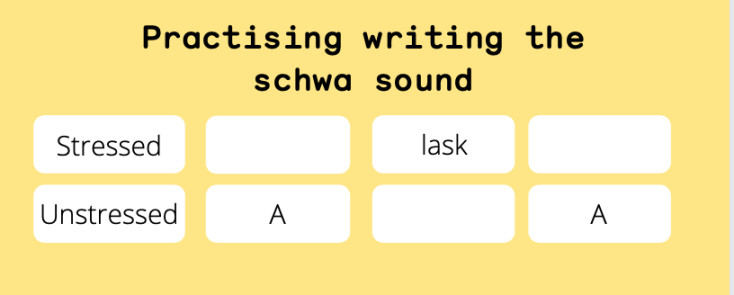
Students can lower their voices for the lowered syllable (unstressed sound) and raise their voices for the higher syllable (stressed sound).
In this exercise, students will combine the correct sounds with the correct spelling to reinforce both reading and writing skills.
I hope this was helpful?
Please click subscribe at the top of my home page and join for extra goodies sent to your inbox and a freebie for signing up!
Any question please comment below.
Katie x

 Adapted Learning
Leave a comment