
The best way to teach spelling to children
Structure Word Inquiry (SWI) is a scientific investigation of words: their origin, history, word parts and structure come together to tell the story of what words mean, how words are connected and how they are spelt.
The foundational research was conducted by Bowers & Kirby In 2010. Since then others such as Lyn Anderson has also implemented this strategy into schools and tutoring with great success.
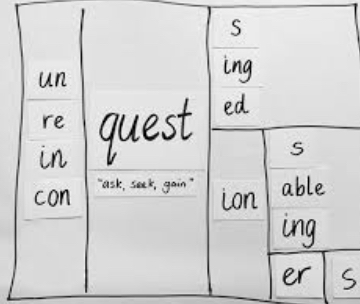
Using linguistic tools such as word sums and lexical word matrices, students analyse words into elements such as bases, prefixes, suffixes. By understanding the spelling of words in the family students make meaningful connections across our language and build proficiency.
The inquiry begins with a question – “what does the word mean?” Children spend time discussing ways to define and interpret a given word.
Next, students look at the composition of the word – “How is the word built? What is in its structure?” This includes identifying the root, prefix and/or suffix and discovering vital clues about the word.
Children get chance to find out the etymology of the word or it history and origin. This helps make sense of its structural elements.
They then look beyond the word to make connections by considering related words, pronunciation etc. “How does pronunciation affect the spelling?”
Using word sums children justify or discredit their original hypothesis and visually represent their findings in a lexical matrix. “What do related words tell me?”
Finally students put together their findings.

 Adapted Learning
Leave a comment